Friday, July 23, 2010

spring leaving

Spring field flowers
field sketch

The field has been seeded with wildflowers.  I go there often to sketch; this sketch, done on site, is large, 22x30."  I tried to work quickly, and you can see that some of the pastel marks barely cover the paper.  That day the field was shimmering with the sky, and the horizon wafted between the two.

Jane Blaffer Owen died on the solstice, the longest day of light, the last day of spring, this year.  She befriended me, and so many others, in New Harmony Indiana.  New Harmony will always carry her art, architecture, gardens, restorations, and her spirit.  With grace, she leaves the world.

Saturday, July 17, 2010

my summer vacation

Elena's back yard


Two weeks away:  time with my sisters H, N, and twin sister Jt, and with light and ocean, garden flowers and big old cypresses.  We walked a lot, we laughed a lot.  Color all around, carried with us even onto the highways and in the airports.

Coming back in the airplane I watched pools and wafts and points of darkness and lights, moving and changing in and out of patterns.  Fields of night and lights.  A bright crescent moon shone alongside for awhile.

The Emigrants by W. G. Sebald I read, travelled with.  There is a passage about memory reaching back, and forth into the present and perhaps beyond, and that memory meanders, foggy, sometimes clear.  I cannot find the passage.  The book is terrific, a dazzlingly rich field of greys and grey-surrounded points of fact/fiction/memory.  Oh here is the passage, from the fourth and final emigrant memoir, "Max Ferber":

     If I think back nowadays to our childhood in Steinbach (Luisa's memoirs continue at another point), it often seems as if it had been open-ended time, in every direction--indeed, as if it were still going on, right into these lines I am now writing.

This passage goes on for awhile, Luisa remembering the path and the kind of memories of her childhood and adulthood, all within the frame of her son Max's memories, as told to the nameless younger narrator of "Max Ferber" who grows older as we travel with him, we readers.   Luisa is remembering even as her world in her present-day Germany becomes narrower and narrower.  (The passage does not include fogginess; I got that wrong, yet fogginess, greyness are abiding motifs throughout the book.)

What a lot of layers and movement--in fields of color, night, or grey--there are in moments of memory.

Friday, July 2, 2010

July 1

July 1

Going west soon:  I'll be gone for two weeks.  This small painting, of flowers in a tangle of field, I did yesterday.  I'll leave it out on view in the studio, too.

chang chang ge

chang chang ge

Chang chang ge is Chinese for "sing, sing, song"  or "lots of singing" or "there is song all around."

The calligraphy here does seem to move around:  from square to square, square with a line through it, square under a line, and there is emphasis and syncopation, lightness and heaviness of touch.  The open square is kou, "mouth." You see kou in the top two changs (and twice, smaller, in the lower character ge).  The other part of chang--the two squares each with an inside line--means "sun," "splendor."  So you have in the Chinese word for "sing" the notion of mouth and sun/splendor.

There is much song around, here in early July.  Robin fledglings are fussing, sparrow parents call out warnings, finches and orioles share the news of newly dried seedheads.  The cicadas have started buzzing eveningtime.  How is there one moment or word for "song"?

Thursday, July 1, 2010

wafts

summer field

Not so much splashes of color as wafts of color, these.  The day was hot and the field buzzing with activity.  Some of the pastel marks almost melt into the paper.  After awhile you are drawing out and about.  The waft-marks become floaters above the field; the breezes, the air become integral with the field.  If splashes of color are water-filled, wafts of color are air-surrounded.

This field I painted on site, with pastel on paper, over a probably six-hour period.  The paper size is 22x30"; it is Fabriano Artistico, 140lb, hotpressed.  I love this paper and use it often.  Especially on a hot day:  the paper itself starts living and acting and interacting.

Saturday, June 26, 2010

flowers moving on a page


Martin's and Ardean's paintings

Watercolor can be like a splash of color-and-light.  Not often, students can newly try it out with seemingly carefree brushstrokes and arrangement.  Martin and Ardean have done so.  Their colors waft in space, as do flowers in a field, don't they!

A wonderful book, The Wild Braid, has in its last poem, "The Round,"  these final lines:

the still-wet words I scribbled
on the blotted page:
"Light splashed . . ."

I can scarcely wait til tomorrow
when a new life begins for me,
as it does each day;
as it does each day.

(The first line of the poem is  Light splashed this morning  .)

Do find the book, find the poem; these lines are only slight enticement for much, in this poem and in the other poems to enjoy!  The book is a collection of poems and reflections about poetry and gardening by Stanley Kunitz, a small, lovely book made at the end of his very long life.

The students who painted flowers in watercolor class with me are not very old; still, they are living in retirement:  and from the long view they have reached because of age, gosh, they were able to see the splashes and so "scribble" and "blot" toward some small, lovely work.  Ageless sparkles.

Monday, June 14, 2010

away

I've sought out returning geese from my March 10, 2010 entry.  As you can see, away is much the same image as returning geese.  (The haiku by Miura Chora in the same March 10th entry is good for me to read again too.)

away
four leaves of bamboo like a wild goose
for my friend

Away:  a friend has gone.  He will not be returning except when I think of him.  Seeing the four leaves of bamboo as returning or as going away imbues, a bit, this still memorial brushpainting with movement, memory that will move, come and go.

Friday, June 4, 2010

trillium

trillium

Everyone who has come by the studio and seen this small painting on the easel--Eric, Sandi, and Deb come to mind--have immediately recognized and exclaimed "trillium!" as if they are heralding a fond, found friend. The trillium are wonderful in our woods.  In the early spring the woods are dark with leaf mulch and with the dampness of the winter melt, so that when these bright white big blooms on bold green leaves appear, they almost shine.  Welcome indeed, these friends.

While I was sketching up north some weeks ago now, driving around I saw hundreds of trillium covering the woods floor.  I brought sketches back of trillium and of the first northern orchard blooms.  Four small orchard paintings and some small sketches later:  only this week did I get to the trillium.

This trillium painting is gouache and pastel and some charcoal.  I hope it is lively, blooming here on the page/screen.  The three blooms with three broad petals nod slightly, I think, here at us.  And they nod to the time two weeks ago or more, when they were out there among us, out there among the trees.

Saturday, May 29, 2010

becoming summer

Abuzzing

Not as dramatic perhaps as a film (as, for example, the film "Becoming John Malkovich," nor as dramatic as John Malkovich or what we think his life is like; yet, this field is dramatic.  There is much going on.  The greens have become full force, overtaking the lilacs and light blues of the Dames Rockets and the tender yellow-greens of early growth.  Some blue shadows and blue distances have appended to the greens, and my-gosh, bits of autumnal russets have appeared.  Not to mention that there has been much insect activity and alifting of leaves and flowers by the bugs and by breezes and by the wafts of car speed from the nearby highway.

In this small pastel painting I have tried to array the paper with high and abuzzing drama.  Spring is still around:  summer is coming:  summer is already much around us.  There is much strength and activity in our fields these days; yes, in our fields at least there is much vigor.

Thursday, May 27, 2010

tree

M is in San Francisco among like-mindeds.  He found out today that the word "truth" is related, through Indo-European paths, to the word for "tree."

A moveable feast, this word-link, this tracing travel; do you know too about this, these?

Friday, May 21, 2010

bluebird in field

Bluebird in field

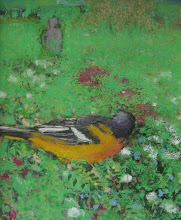
One more time I watched a bluebird pause at our park, which of course can look like a field.  Who is to say for the bluebird?  So I made another, fuller image of the bluebird with green "field" all around.  This bluebird is alert, almost quivering.  He did not stay long.  Most years I do not see a bluebird after early spring.

This pastel painting has many layers, so that the printmaking paper will probably bow a bit whenever the humidity becomes high.  If I frame this, I will ask Bud to add a separator between the mat and the paper so that the paper can move more easily with the humidity changes, and so that if any particles of pastel drop, they can drop off between the mat and the paper rather than on the mat.  Bud uses 4-ply matboard strips as a separator.   Some framers use plastic strips that align with the outside edges of the mat and the rabbet of the frame.  Pastel painters use fixative--a kind of sprayed varnish---to fix the pastel particles in place, but some particles inevitably drop over time.  And here in this painting, there are many layers of pastel and a paper that might slightly move:  a call for special care.  This bluebird is still and ready to move:  we'll be prepared as best we can to watch!

Wednesday, May 12, 2010

these lines

These lines by Philip Levine can center me and can carry me, like a mantra.  I keep coming back to these lines, and at one studio I had them up on the wall.

Fact is silence is the perfect water:
unlike rain it falls from no clouds
to wash our minds, to ease our tired eyes,
to give heart to the thin blades of grass
fighting through the concrete for even air
dirtied by our endless stream of words.

Aren't they wonderful!  These lines are from a longer, entirely wonderful poem entitled "He Would Never Use One Word Where None Would Do"  from a book entitled THE MERCY.

I smile widely now when I see his grass blades fighting through the concrete, like Sisyphus, like Detroit (where Philip Levine grew up), like anyone's even small urges to the better, like me amid all the noise I can make and have around me.