Showing posts with label flowers of the field. Show all posts
Friday, August 10, 2012
bay
Bay is all about lake, sky, and land. We are high here, looking down at the bay and, seemingly, across with the sky! This is a quick color sketch, with some amount of detail and layering in the field. The sky is quite close to the paper. The field is partly dried, partly in flower. The colors are slightly more violet, and the field flowers are different; still, there is some resemblance of our northern bay with the Mediterranean near Cap d' Ail or Nice.
Labels:
bay,
Cap d' Ail,
flowers of the field,
L'amandier en fleur,
lake
Wednesday, August 8, 2012
near Suttons Bay, August 1
near Petoskey, July 31
The same field flowers are in these views, seen a day apart. One field has color in the field flowers; the other field's grasses and flowers are already quite dried out, seeds and seed heads much more predominant than flowers. Suttons Bay is in a protected bay of Lake Michigan. Petoskey is farther north and the bay there is more open to weather from the west over Lake Michigan. Diane told me that Suttons Bay just didn't get much rain this summer; the rain has passed over and passed to the north often.
The top painting here is the same field as the field in the previous post, three weeks later. I was leaving the hill and the small house and shed caught my eye, almost engulfed by the fields. Of course the house is important here, centered; still, the fields provide its stage, its display.
Labels:
autumn,
flowers of the field,
lake,
Petoskey,
Suttons Bay
Sunday, August 5, 2012
between developments
hill overlooking Suttons Bay
This small painting I did in the studio, from a watercolor sketch on site. The site is a hill in northern Michigan's Leelanau Peninsula looking down toward a bay of Lake Michigan.
I sat in my car to do the watercolor. There is a dirt two-track in view at the lower left. This path comes up to a paved lane, where I'm parked. This lane is part of the infrastructure for a whole new subdivision: paved lanes, cul-de-sacs, fire hydrants, power cables. The big hill has been set up for houses; a big cherry farm was bull-dozed to make way for the development. Behind me here, just up the hill further, there are 5 houses, almost finished but boarded up, windows broken. One house is partially painted. This development stopped, went bankrupt.
As long as I did not look behind me, the view was dazzling.
Tuesday, August 30, 2011
field of the goldfinches
August field
The flowers in the fields will soon be brown, their seeds flown, dispersed, or eaten, but not yet. Goldfinches have been flitting in the fields, eating the seeds on thistles, bee balm, and coneflowers. Goldfinches are BRIGHT yellow birds, and the fields still have colors, so a lot of bright dance is on.
I went to this field this morning and did a pencil sketch. All last week I was in the world of medical detail. Everyone there tries to dance well; still, I was glad to be here again for a while.
Wednesday, July 13, 2011
Wednesday, June 22, 2011
blue flags
blue flags in the field
Blue flags are a wild iris that grow around here. They are small and fine, delicate. Yet, they are tough, they will not give up their patch of field easily, and they can spread if they have enough water. The ones I saw were almost hidden, surrounded by field. Here, the painting has lifted them high in the field, undaunted by the grasses or the woods beyond.
Saturday, September 25, 2010
color studies
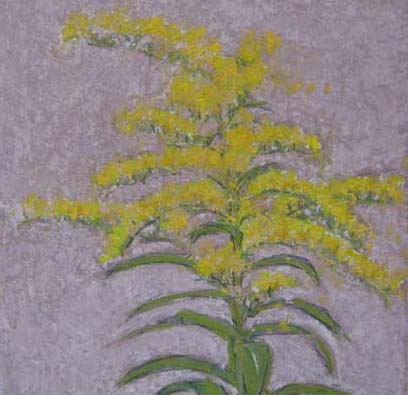
goldenrod
asters
Working on a large painting takes much time. I'm on my feet six or seven hours of the day when I paint. And often I paint on the same large work until I see it start to move--some days out from the start-- or until the tone up-lifts, or until something else starts stirring.
I simply pause sometimes: a small color study or two at my drawing table can remind me that there is a middle and end to image-making. Then I return to the large painting and usually the path ahead in it appears clearer, the time ahead less clumped to the past days.
The two small studies above are pastel and gouache on paper. Each study is stylized, individuated, stilled. Actually, asters and goldenrod are group-dwellers: many, many, blooms are on each clump and many clumps abide in broad patches in the fields.
Sunday, September 19, 2010
color casting
September field
I did this small painting on September 12th. I've decided to keep it; I've matted it (so, probably I will not work on it more at a later time). Already the fields have moved on.
Yellows and golds cast widely in the fields now. In the treelines yellows and ochres are mixing with the greens. Cool violets show more: golds can affect the greens that way. Soon the Autumn Fire Colors will blaze forth. Til then, this golden field furriness nearly makes my arms shiver. The furriness moves. Can you see/feel this field/this movement too?
Friday, August 20, 2010
away from green
middle August field
click on sketch to enlarge
Field colors are leaving green. Each day shows more and more spent, drying, browning stalks and flower heads that are going to seed. There are blooms still and even some new blooms. Goldenrod is moving from green to gold. Joe Pye weed is becoming less carmine, dustier, dustier. Lemon-yellow blooms of late-year primroses bob, tall in the breezes. Queen Anne's lace is curling up everywhere, dunn-green, almost brown, almost ashy. But, still in the fields, also, some Queen Anne's lace is startlingly white, lacey, crisp. Around the blooms the greens are changing, frosting with mildew from humidity of the days and the nights' coolness or simply giving up, no more chlorophyll coming through: too much sun finally and night hours that are advancing.goldenrod & primrose in the field
In these small paintings, I have the autumn colors underneath and starting to appear above the greens.
Labels:
autumn,
flowers of the field,
Queen Anne's lace,
wafts
Monday, August 9, 2010
curly dock
liatris, goldenrod & curly dock in the field
The curly dock is the dark dry brown "bottlebrush" in the fields in August. This image is from last year's autumn paintings; this year we are not seeing the goldenrod fully flaming yellow yet. Maybe we will in another two weeks.
So almost a year later, I am still working in this format: 8x10" or 10x8" views from the fields and treelines. This image, like the others, is done on a printmaking paper, Stonehenge or Rives BFK. (For larger pastel painting especially, a favorite paper is 140 lb. Fabriano Artistico, hot-press [smooth, not so much textured] watercolor paper.) I use several finely sprayed layers of fixative, even on the small works. I make my own fixative sometimes, and I also like to use Weber Blue Label fixative. The layering colors are mostly soft pastel, with some charcoal and lead and graphite pencil marks. The pastels I most often use are the soft, buttery ones from Sennelier and Schminke, and the slightly harder kaolin-based ones from Rembrandt and Winser Newton. I use other pastels sometimes, but these are my "regulars."
Many years ago I would sometimes use touches of oil pastel, for nubby texture, in combination with the soft pastels, but I have some concern for the non-drying aspect of the mineral oil in oil pastels. Will there be holes eaten into the paper where the nubby texture marks used to be? Will the nubby texture marks become darker and darker? Still, if a painting's surface changes over the years, it is still the same painting, yes? The same painting with, maybe, more dark curly dock than it had earlier!
Saturday, August 7, 2010
autumn fields
![]() |
| queen anne's lace & tickseed in field |
![]() |
| liatris & coneflowers in field |
sweet peas, spotted knapweed & bee balm in field
We have quite a few colorful characters in the fields nowadays. They have wonderful names: Queen Anne's lace, Spotted Knapweed, Tickseed, Coneflowers, Sweet Peas, Black-eyed Susans, Bee Balm, Goatsbeard, Bladder Campion, Bouncing Bet, Smartweed, Curly Dock. And of course there are the grasses, turning from green to all kinds of russet reds and siennas. Dried seedheads that have turned brown and dull brown can yet erupt from their color-stillness whenever a goldfinch or purple finch or hummingbird alights upon them.
The small paintings are mostly pastel, on a printmaking paper. Each has quite a few marks and so a good amount of layering, which, still, only translates a bit of the multifarious field activities.
Friday, July 2, 2010
July 1
July 1
Going west soon: I'll be gone for two weeks. This small painting, of flowers in a tangle of field, I did yesterday. I'll leave it out on view in the studio, too.
Thursday, July 1, 2010
wafts
summer field
Not so much splashes of color as wafts of color, these. The day was hot and the field buzzing with activity. Some of the pastel marks almost melt into the paper. After awhile you are drawing out and about. The waft-marks become floaters above the field; the breezes, the air become integral with the field. If splashes of color are water-filled, wafts of color are air-surrounded.
This field I painted on site, with pastel on paper, over a probably six-hour period. The paper size is 22x30"; it is Fabriano Artistico, 140lb, hotpressed. I love this paper and use it often. Especially on a hot day: the paper itself starts living and acting and interacting.
Saturday, June 26, 2010
flowers moving on a page
Martin's and Ardean's paintings
Watercolor can be like a splash of color-and-light. Not often, students can newly try it out with seemingly carefree brushstrokes and arrangement. Martin and Ardean have done so. Their colors waft in space, as do flowers in a field, don't they!
A wonderful book, The Wild Braid, has in its last poem, "The Round," these final lines:
the still-wet words I scribbled
on the blotted page:
"Light splashed . . ."
I can scarcely wait til tomorrow
when a new life begins for me,
as it does each day;
as it does each day.
(The first line of the poem is Light splashed this morning .)
Do find the book, find the poem; these lines are only slight enticement for much, in this poem and in the other poems to enjoy! The book is a collection of poems and reflections about poetry and gardening by Stanley Kunitz, a small, lovely book made at the end of his very long life.
The students who painted flowers in watercolor class with me are not very old; still, they are living in retirement: and from the long view they have reached because of age, gosh, they were able to see the splashes and so "scribble" and "blot" toward some small, lovely work. Ageless sparkles.
Saturday, May 29, 2010
becoming summer
Abuzzing
Not as dramatic perhaps as a film (as, for example, the film "Becoming John Malkovich," nor as dramatic as John Malkovich or what we think his life is like; yet, this field is dramatic. There is much going on. The greens have become full force, overtaking the lilacs and light blues of the Dames Rockets and the tender yellow-greens of early growth. Some blue shadows and blue distances have appended to the greens, and my-gosh, bits of autumnal russets have appeared. Not to mention that there has been much insect activity and alifting of leaves and flowers by the bugs and by breezes and by the wafts of car speed from the nearby highway.
In this small pastel painting I have tried to array the paper with high and abuzzing drama. Spring is still around: summer is coming: summer is already much around us. There is much strength and activity in our fields these days; yes, in our fields at least there is much vigor.
Wednesday, April 7, 2010
winter to spring
Spring edge of the woods
Colors are coming out of the earth now. Winter—having been mostly about the skies and what was coming through the skies—is now receding as the earth activity presses and opens up. The days—despite still having fits of fierce wind and weather--are mostly about what the earth is up to: what is new, what is coming, colors.
Royal blue scilla and blue-violet glory of the snow and their green leaf clumps are just up. Daffodils are bold and bright. Yellows, lemons, whites, and with dashes of orange, they are high and trumpet-like in their green clumps, above the siennas of the leaf mold and still-damp earth. The bushes show full buds, a few blooms. Some floating yellow forsythia branches are at our woods’ edge. The trees are loaded with catkins, which show as dusty red or dusty gold fuzz around the dark limbs. Full color is rising. Any day now trees and bushes will become color (not lines). And they will buzz. All on earth is starting to teem.
Spring edge of the woods came together quickly, and I used many small marks: of pastel, charcoal, and graphite. I kept it as a sketch rather than develop it further (by defining the daffodils more, for example, or by adding white scilla or violets which were in my pencil thumbnail sketch) because there was a sense of vitality about the sketch.
early spring and rain
Early spring and rain is a small pastel-on-paper painting that I did a day after the sketch above it. On my drive to the studio, I had seen this patch of our neighborhood. Out of rain-soaked air and earth, these trees and lawn came in and out of focus. This “waftiness” of the view, as much as the trees and lawn themselves, is what I was trying to suggest.
Often my style of painting diverges depending on what prompts the work in the first place. I do not mind losing some stylistic cohesion sometimes; still, I do lose some stylistic cohesion sometimes!
Sunday, March 21, 2010
thankyou Dylan Thomas
Is there any line in English poetry that better heralds spring than this line from Dylan Thomas:
The force that through the green fuse drives the flower
Drives my green age;
Every spring, again this spring, this line comes to me. Thankyou Dylan Thomas. Here is the entire poem, whose title is the same as the line above.
The force that through the green fuse drives the flower
Drives my green age; that blasts the roots of trees
Is my destroyer.
And I am dumb to tell the crooked rose
My youth is bent by the same wintry fever.
The force that drives the water through the rocks
Drives my red blood; that dries the mouthing streams
Turns mine to wax.
And I am dumb to mouth unto my veins
How at the mountain spring the same mouth sucks.
The hand that whirls the water in the pool
Stirs the quicksand; that ropes the blowing wind
Hauls my shroud sail.
And I am dumb to tell the hanging man
How of my clay is made the hangman's lime.
The lips of time leech to the fountain head;
Love drips and gathers, but the fallen blood
Shall calm her sores.
And I am dumb to tell a weather's wind
How time has ticked a heaven round the stars.
And I am dumb to tell the lover's tomb
How at my sheet goes the same crooked worm.
The force that through the green fuse drives the flower
Drives my green age;
Every spring, again this spring, this line comes to me. Thankyou Dylan Thomas. Here is the entire poem, whose title is the same as the line above.
The force that through the green fuse drives the flower
Drives my green age; that blasts the roots of trees
Is my destroyer.
And I am dumb to tell the crooked rose
My youth is bent by the same wintry fever.
The force that drives the water through the rocks
Drives my red blood; that dries the mouthing streams
Turns mine to wax.
And I am dumb to mouth unto my veins
How at the mountain spring the same mouth sucks.
The hand that whirls the water in the pool
Stirs the quicksand; that ropes the blowing wind
Hauls my shroud sail.
And I am dumb to tell the hanging man
How of my clay is made the hangman's lime.
The lips of time leech to the fountain head;
Love drips and gathers, but the fallen blood
Shall calm her sores.
And I am dumb to tell a weather's wind
How time has ticked a heaven round the stars.
And I am dumb to tell the lover's tomb
How at my sheet goes the same crooked worm.
crocuses, spring
Monday, March 15, 2010
daffodils
daffodils in field
These daffodils are up before the daffodils outside are. That is because I hung this painting Saturday at an exhibition space. The painting is up; the daffodils are showing! Outdoors the daffodils are only stubby shoots. Each day now, more show themselves coming through. Funny looking (and what a funny painting they'd make): still, these stubs are mood-brightening!
The painting here is oil on canvas, quite large for me: 30 x 40 inches.
Thursday, February 25, 2010
tulip, tulip
I had been drawing tulips before and after the Easter painting. Good thing. Yesterday I set up to do some small gouache paintings of tulips. But when I came back after a lunchbreak to actually start, the tulips had burst open in their vases so far that petals were flattened like an open hand. Some petals were already fallen onto the table. I did these two sketches anyhow, from my memory of the white tulips and from my drawings.
Whenever I pause to look at paintings of tulips, I think of a wonderful book, Still Life with a Bridle by Zbigniew Herbert (translated from the Polish). The book is small, 8 x 4.5 inches, 165 pages of writing; it is exquisite and sturdy. Its subtitle is Essays and Apocryphas. Herbert wrote the book after he travelled to Holland to explore the Dutch seventeenth century through paintings. One of the chapters is titled The Bitter Smell of Tulips and it starts with this line: Here is a story of human folly. The one image of our edition is on the cover: a tulip.
By the way, it is said that tulips do not have a smell and I think this may be so. Yes?
Monday, October 12, 2009
chrysanthemum

We go to Gretchen's cabin when we can, once or twice a year. We walk around in the woods, unless it's raining heavily as it was Saturday, and we have a wonderful lunch at the round oak table. Then we clear the table and set up for painting practice. This time at the cabin we had three vases of autumn flowers on the table with us, many of them chrysanthemums. Chrysanthemum is one of the four friends of traditional Chinese painting. It is the flower that "braves the frost." Below is a footnote about painting the four friends:
As with orchid, bamboo, and plum, painting the chrysanthemum as an independent subject was a fairly late development (about the x century), inaugurated and influenced by the literati. The associations of the chrysanthemum as the flower of late autumn, announcing the coming of winter and able to blossom in the cold, were developed through the xiii century.
This footnote is on the first page of the chapter on Chrsyanthemum Painting in The Mustard Seed Garden Manual of Painting, which was first published, in stages, in the late 1600s. Besides bravery, pride and dignity are ascribed to the chrysanthemum in the chapter. My sketch is quite simple. I used charcoal and zinc white with a touch of grey green. The stem is darker green. The sketch needn't suceed; I was just spending time with the upright-graceful bloom. While I was at it, I did two quick watercolor sketches of thin branches outside the oak table's window. Here is one of them. 

Subscribe to:
Posts (Atom)