Showing posts with label you too?. Show all posts

Thursday, July 11, 2013

sea paintings


 beach at Cape Cod near the Crosby house

For several weeks I've tried to finish this painting, but I stop.  I like the simplicity and the power in the sky.  You can tell from the sketch below, done on site, that the sky indeed was fast-moving, dark, forceful.


Milton Avery often painted beaches and the sea in Maine, and he simplifies.  His paintings are wonderful, and often large (but not huge). Here is one:

Milton Avery painting

You can see other Milton Avery paintings reproduced on a fine-looking blog:
http://danielgalas.blogspot.com/2012/05/hilton-kramer-milton-avery-and-arthur.html  .

Sally Michel Avery also does wonderful paintings.  They both painted during a long lifetime together.  Here is a painting by Sally:

Sally Michel Avery painting

Mark Rothko has credited Milton Avery as being influential to him.  The history and stories and visual conversations of painters and among painters is fun for me.  You too?

Sunday, April 15, 2012

Spring wild


We are having wild growth and color, every day anew.  You too?

Wednesday, October 26, 2011

making note of

A lovely, companionable book that I came across recently is Greene on Capri, A Memoir, published in 2000.  The author is Shirley Hazard.  The Greene is Graham Greene, the marvelous writer, prickly person, and Capri, of course, is the astonishingly beautiful cliff-made island off the coast near Naples Italy.

Shirley Hazard did not make notes of (nor did she tape-record) the conversations she had with Graham Greene. Here is what she says about recall:

Over our years of Capri meetings, I seldom made "notes" after conversation with Graham and Yvonne.  An underlying intention to record changes the nature of things, blighting spontaneity and receptivity: an imposition.  Like the snapping of photographs.  In our appointments diary I sometimes find hieroglyphic reference to the evenings at Gemma, a few words of recall.  One remembers long and well, and without prompting, what is truly interesting--the moments that, pondered, shared, revised, become part of the inward legend.  

(She means by "snapping of photographs" here the substitute activity of looking, not the kind of photographing wherein the photographer/artist shares the life of her subject and, oh, can capture it in a still image so that we can share a bit of the life too [see Sue's wonderful photos in the next blog below here!].  Don't you think so?)  Sketching, for me, feeds my inward legend, my map of significant images.  And you?  How do you recall salient features of people or places that you come across?

sketch while visiting Leelanau

Wednesday, June 15, 2011

woods and flowers

rhododendron and woods

Back and forth between the cultivated and the wild:  most of us like to go there:  you too?

This little painting started as a site sketch at the large garden of a nearby school called Aquinas.  The painting, mostly pastel, also looks emblematic of the site where our friends S and Fr live on Cape Cod.  Their house's yard is surrounded by very large rhododendrons, and the yard verges in the back up to 800-plus acres of protected woods.  We have been much thinking of our friends this month, so this scene, rhododendron and woods, getting through onto my paper as two places, not one, shouldn't surprise me.

Sunday, April 3, 2011

tsunami dog

Tsunami dog

Tsunami dog will forever move in our imagery.  She is still, watching us here in this photo:  go to  Tsunami Dog  and click on PLAY and you will see our dog alive, moving, survived three weeks after the tsunami of Japan.  Our dog is a wonderful story during a terrible time.

Our dog of Pompeii did not survive.  So many and so much were destroyed by the burning lava of erupting Mt. Vesuvius so many years ago.  Pompeii dog remains to us still, unmoving--a replica-cast in a viewing case, a photo, a preserved life, a terrible testament of a terrible time.


Pompeii dog

Though AI-JANE titles itself as "still words and images in a moving world," I consider the image, moving, of Tsunami dog extraordinary enough to be an exception.  You too?

Thursday, March 31, 2011

bird of spring

robin

In our family, each year at the end of winter whenever we see a robin reappear, we report to each other.  Some of our family now live outside the zone where a robin, returned, can signal spring; still, those outsiders get the report about our sightings nonetheless.  You too?  Do you watch for a certain bird?

This small painting has various layers of pigment, charcoal and graphite, and fixatives.  I tried for a solid bird (our robins are big birds) with some bit of movement.

Do you know the pastel paintings of R.B. Kitaj.  They are wonderful, masterful, with much movement.  And though his subjects are mostly people in places, his people have avian tendencies, it seems to me.

Saturday, February 26, 2011

spring, forced

daffodils

The daffodils were blooming because a grower had "forced" the bloom early, inside.  Sandi forced a branch of redbud from her yard last week, and she brought the successfully blooming branch to class on Tuesday for us to see.  I like the meaning of the word "force" here.  You too?

My studio is in a building owned by a floral company.  Deb, who is in charge of all the potted plants, had some daffodils out on the back racks this week.  The daffodils looked good, but they were on their way out of bloom (probably they were brought in to sell for Valentines Day, the 14th).  I borrowed a pot of daffodils and did some small color sketches.  Here is one of them.

Friday, December 31, 2010

old year/ new year

winter field

Rain today has dissolved most of our snow.  Yesterday, at this nearby field, snow was not thick but still it dissolved most of the recognizable forms.  The grasses, the young trees, and the far treeline came in and out of definition, depending upon whether I fixed my view upon them or upon the snow or upon the winter-grey sky.

The year changes tonight.  2011 will become distinct at times from other years.  A vast field:   I'll move in and out of it, forward and backward, around and around.  You, too:  best wishes, Happy New Year!

Thursday, December 9, 2010

re-visons

November late field II

This field painting is revised.  It is a re-vision of my last post's image, a tweek.  The goldenrod-like passages are a bit stiffer/drier than before.  (They were just a bit "damp" or merged with the other in the previous painting, I decided.)  Words are difficult explainers when the tweeks are so slight.  Can you see the difference?  Please excuse me this revision; I did think the painting was finished when I posted it here.

Jack Levine talked about his troubles finishing paintings.  His gallery would send a truck to pick up a painting, and the truck would go back, empty, time and time again.  Also, this "trouble" of his:  I remember a truly wonderful large painting of Susanna as a child that hung in their living room whenever I was there (first, when I was studying with Ruth and then, when visiting); Jack would ocassionally gaze upon it and remark that maybe it would be finished soon.  When I first heard this comment, Susanna was a young married woman.!

We re-do, don't we, all of us, even if we are not painters.  Something about respect for the subject there, isn't there?

Tuesday, November 16, 2010

bear fields

november field

The fields are devoid of living-growing colors, almost.  Pockets appear--still-green grasses and leaves, blooms not quite spent.  Mostly, all is enveloped:  all is moving in the breezes--textured-- but uniformly neutral:  browns, greys, whites.  The fields of grasses and dried plants are the colors of bears.  I find these bear fields wonderful.  You too?

My challenge as I painted this field was getting a sense of the under and the over in the pocket of the field without too much drama!  Underneath are the colors of the season-past; over and around are the colors of the season-ahead.

Saturday, November 13, 2010

blue jay again

The young blue jay (from the previous post) is now up north at Alyce's small gallery.

Here is E.E. Cummings's poem about a blue jay, "crazy jay blue)":

crazy jay blue)
demon laughshriek
ing at me
your scorn of easily

hatred of timid
& loathing for(dull all
regular righteous
comfortable)unworlds

thief crook cynic
(swimfloatdrifting
fragment of heaven)
trickstervillain

raucous rogue &
vivid voltaire
you beautiful anarchist
(i salute thee

I love the (swimfloatdrifting/  fragment of heaven) .
(I salute you, E.E.!)  You too?

Wednesday, November 10, 2010

blue jay

young blue jay, at  you

The young blue jay looked over from the lilac bush just beyond our deck.  I get this look from blue jays when they are looking around at me, as if to say "where are the peanuts that you usually put out?"  Does this young one already know about the peanuts?

This is my third small painting of the blue jay.  Two of them didn't work.  The challenge was getting all the detail of the markings and a sense of the bird in motion, stilled for a moment.  Details can so easily take over the view.

M showed me a poem by E.E. Cummings about blue jays.  A phrase, "hatred of timid," struck me as too strong, too jarring.  But the rest of the poem was wonderful.  Now I think I will look again at the poem and see if my view has changed.  Maybe you would like to see the poem too, with all its phrases, all its details!

Thursday, October 7, 2010

color catching

october field

Autumn, jewel-like, can bedazzle at any moment:  asters flash from out of a shadow, goldenrods light up out of the browning grasses, sky-blue becomes bluer beside the gold.  A tree turns crimson between field and sky.  The jewels startle us and lead the fields in jumping.  Autumn is leaping in the fields.

I've tried to get this small painting jumping if not startling.  Maybe your eyes move around in an odd and syncopated way, darting around, their haunches and belly catching and dragging amid the fields and colors.  Do they?

Sunday, September 19, 2010

color casting

September field

I did this small painting on September 12th.  I've decided to keep it; I've matted it (so, probably I will not work on it more at a later time).  Already the fields have moved on.

Yellows and golds cast widely in the fields now.  In the treelines yellows and ochres are mixing with the greens.  Cool violets show more: golds can affect the greens that way.  Soon the Autumn Fire Colors will blaze forth.  Til then, this golden field furriness nearly makes my arms shiver.  The furriness moves. Can you see/feel this field/this movement too?

Thursday, May 27, 2010

tree

M is in San Francisco among like-mindeds.  He found out today that the word "truth" is related, through Indo-European paths, to the word for "tree."

A moveable feast, this word-link, this tracing travel; do you know too about this, these?

Saturday, May 8, 2010

between flitting

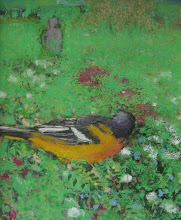
Baltimore Oriole perched, turning

This oriole did not stay around long.  He came into our yard, flitted sideways a few times, sang enormously for awhile, and then was away.  I have not seen him again, three days later now.

Alarming color he flies in with.  Do you have a similarly colored bird in your area?  (Nb. We do not live in Baltimore.)

Bluebird perched for a moment

The park across the street almost looks like a field.  So the bluebird paused there.

This sketch is close to the paper, that is, you can see all the strokes that I used, coming "up" from the first charcoal strokes to the colored watercolor and gouache strokes. (And I left the charcoal here rather than, say, bring in a background color to surround the bird.)   Gouache is basically watercolor with an opaque white, zinc white, added to it.  Often I mix white with my watercolors as I sketch, to give the color some "body" as well as opacity.  European art writers used to use the term "body color" in their descriptions of sketches and I think they were referring to gouache or maybe to lightly-dampened pigment or pastel.  Dry pigment or powdered charcoal and pastel can add wonderful grit and body to brushstrokes of paint.   Paint and pigment and pencil and white and whatever can all mix in in many ways.  Without regard to definition, they flit around, these mixtures!  Still, in the moments that they pause, they can start to form brushstrokes or words, or after awhile, a bird.

Sunday, May 2, 2010

Spring-ing

Spring, Leelanau


Spring racing ^
Spring bursting v
We are
inspiring,
inSpringing,
this Spring:

you too?


Spring, bursting