Sunday, April 3, 2011

tsunami dog

Tsunami dog

Tsunami dog will forever move in our imagery.  She is still, watching us here in this photo:  go to  Tsunami Dog  and click on PLAY and you will see our dog alive, moving, survived three weeks after the tsunami of Japan.  Our dog is a wonderful story during a terrible time.

Our dog of Pompeii did not survive.  So many and so much were destroyed by the burning lava of erupting Mt. Vesuvius so many years ago.  Pompeii dog remains to us still, unmoving--a replica-cast in a viewing case, a photo, a preserved life, a terrible testament of a terrible time.


Pompeii dog

Though AI-JANE titles itself as "still words and images in a moving world," I consider the image, moving, of Tsunami dog extraordinary enough to be an exception.  You too?

Thursday, March 31, 2011

bird of spring

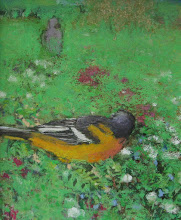
robin

In our family, each year at the end of winter whenever we see a robin reappear, we report to each other.  Some of our family now live outside the zone where a robin, returned, can signal spring; still, those outsiders get the report about our sightings nonetheless.  You too?  Do you watch for a certain bird?

This small painting has various layers of pigment, charcoal and graphite, and fixatives.  I tried for a solid bird (our robins are big birds) with some bit of movement.

Do you know the pastel paintings of R.B. Kitaj.  They are wonderful, masterful, with much movement.  And though his subjects are mostly people in places, his people have avian tendencies, it seems to me.

Sunday, March 20, 2011

shadow and sunrise

March shadow, sunrise, thaw

Tetsuo, Takako, and Kentaro are OK.  We got this news in an email from Tetsuo, from Tokyo, yesterday.

Thursday, March 17, 2011

Dream over withered fields

The last poem of the great Japanese poet Basho goes something like this:  (the translation is in Robert Hass's book, "Twentieth Century Pleasures")

Sick on a journey,
my dream hovers
over the withered fields.

Tabi ni yamite yume wa kare-no wo kakeme guru

Or, the translation could go:
as for Dream:  it hovers over the withered fields

We think of the Japanese and their distress and their withered fields, and our hearts go out to them.


In calligraphy Tuesday night, we brushed three characters for "dream hovering."


Wednesday, March 9, 2011

mandorla

winter to spring, finch

Goldfinches have returned en masse.  The finches' indeterminate color has a delicate sheen, almost a glow.  Soon enough the males will molt into bright gold plumage.    M has suggested "mandorla" when I asked him about the word "penumbrous" for the kind of glow that they show.  Mandorla is Italian for "almond," and it means an almond-shaped area of light in paintings (as in, especially, depictions of the resurrected Christ or Mary in the Assumption).  What a wonderful word.

You can see most of the pencil sketch in the finch above, and most of the first gouache layer of evergreens in the surround.  The finch here is on a branch; the one I saw was on a tube feeder.  This painting is a little roughly translated and unfinished-looking I suppose.   Still, I see the finch again in the painting.  And that is enough.  

Saturday, March 5, 2011

winter still, long

late winter, late afternoon, evergreens

Three evergreens were catching light and snow and casting long shadows, the foreground inter-changing with the background.  Never mind that it is still winter!  These three figures and their drama compelled me to sketch.

Alyce has asked for this painting to appear in a magazine and in her gallery.  Much of my work has been sitting during the winter.  Soon this one, and then the others will start going out, will start to appear (aper, ap parere) out.

Wednesday, March 2, 2011

Cranes again

Sandhill cranes in Florida, remembered

We all await cranes and geese flying north again.

I've done this small sketch with pastel and glue-water.  Distemper (or distempre in French) is painting with pigments suspended in glue, so my sketch here has some look of a distemper. Vuillard has done incredibly beautiful paintings with distemper, incredible because distemper is difficult to work with over an extended surface and build-up.

Saturday, February 26, 2011

spring, forced

daffodils

The daffodils were blooming because a grower had "forced" the bloom early, inside.  Sandi forced a branch of redbud from her yard last week, and she brought the successfully blooming branch to class on Tuesday for us to see.  I like the meaning of the word "force" here.  You too?

My studio is in a building owned by a floral company.  Deb, who is in charge of all the potted plants, had some daffodils out on the back racks this week.  The daffodils looked good, but they were on their way out of bloom (probably they were brought in to sell for Valentines Day, the 14th).  I borrowed a pot of daffodils and did some small color sketches.  Here is one of them.

Friday, February 25, 2011

spring, hopes

Hopes in new growth--of plants, seeds, yard and garden areas, travels--arise with spring.  Look at this wonderful poem about hope or, if you will, about language, about life, about art!  Last week M met Nuala Ni Dhomhnaill, the poet.  She said to him about this poem that, at one point in a busy day with much and much with the children happening, she wondered to herself  WHAT WAS SHE DOING? WRITING POETRY IN THIS LANGUAGE THAT PEOPLE DIDN'T READ ANYMORE?  CRAZY!  And then she began writing the poem.  She writes in old Irish, Gaelic, and I have copied the Irish title here but not the Irish words of the poem, alas.  (You can find them, yes.)  The translation here is by Paul Muldoon.

Ceist na Teangan
(The Language Issue)

I place my hope on the water
in this little boat
of the language, the way a body might put
an infant


in a basket of intertwined
iris leaves,
its underside proofed
with bitumen and pitch,


then set the whole thing down amidst
the sedge
and bulrushes by the edge
of a river


only to have it borne hither and thither,
not knowing where it might end up;
in the lap, perhaps,
of some Pharaoh's daughter.


  -Nuala Ni Dhomhnaill    c.

Thursday, February 24, 2011

early spring

    
     With white plum blossoms
these nights to the faint light of dawn
     are turning.


(Shiraume ni akuru yo bakari to nari ni keri.)


The poem is by Buson, an eighteenth century Japanese poet and painter.  (The translation is by Edith Shiffert, in a book by Robert Hass, Twentieth Century Pleasures.)

We have more snow, and more snow will come tonight.  Still, any moment, we will see a bloom outside.  And seeing the bloom will fix a moment amid the turning from winter to spring.  The poem above is Buson's last poem.  He dictated it to his friend Gekkei, then fell asleep and died before morning.  "That one," he is said to have murmured, "should have a title, "Early Spring.'"

Thursday, February 17, 2011

Dawn, thaw

Dawn, thaw

"Rosey-fingered dawn" is Homer's famous description.  My sketch (see below) says "orange creme" to describe the color of dawn that I woke up to yesterday.  How wonderful the dawn:  can I paint that color, that wonderful dawn?

At the foreground of the pencil-sketched field (below) is "tan dust," or thawed snow, which is not a great color but, still, a wonderful sight after months of earth-covering snow.  In the small painting, I have suggested the thaw with some of the paper showing under the shadowy blue.  I have suggested the dawn light with strong color.  The night-darkened treeline has only some detail; it is still waking up.

As I worked on this painting, I wondered if it would be the last winter view on my drawing table for awhile.

Dawn, thaw preliminary sketch

Wednesday, February 9, 2011

out of winter for a week

sandhill cranes

Three Sandhill Cranes walked into the back yard while Mother and I were having lunch last Tuesday at her house in Florida.  Last Thursday also, after lunch, I saw two Sandhill Cranes meandering in the back yard of Mother's neighbor Pattie. 

This sketch of Sandhills I did two weeks ago, up here in my northern Midwest studio, after leafing through a wonderful book, On Ancient Wings: The Sandhill Cranes of North America by Michael Forsberg.  How wonderful then for me to see these cranes in Florida when I was there, so soon again, and, you know, real!

I was in Florida for a week, the week when the Midwest and much of the rest of the country got blasted by snow and ice and winds and cold.   I suppose it is fitting then that my previous blog entry, the small painting of a blizzard, stayed as the current image on view here at Ai-jane during that week of icy storms.  Still, I like seeing cranes at any time, and this sketch of cranes, though simple, has a bit of the softness and stalk-iness of cranes coming through the charcoal strokes.  The simple view of cranes, in the midst of still-immense winter, pleases me.  You too?