Saturday, November 2, 2013

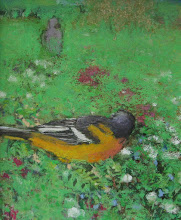
sky colors

pastel/paper
by Katherine Irish

Katherine Irish has a wonderful collection of paintings on exhibit now in  Convergence Gallery  in Santa Fe.  Katherine is a master colorist, and she loves New Mexico.  The colors waft in the sky.  Bravo!

Thursday, October 3, 2013

Peregrines

Peregrines

Soon they will kill the falcons that breed in the quarry,
(it's only a matter of time:  raptors need space
and, in these parts, space equals money):

but now, for a season, they fly low over the fields
and the thin paths that run to the woods
at Gillingshill,

the children calling out on Sunday walks
to stop and look
and all of us
pausing to turn in our tracks while the mortgaged land

falls silent for miles around, the village below us
empty and grey as the vault where its money sleeps,
and the moment so close to sweet, while we stand and wait

for the flicker of sky in our bones
that is almost flight.

The poet is John Burnside.  He lives in Scotland, where he now teaches.  He was born in 1955.
The lovely flutter of co-life in the ending lines is wonderful.  The whole poem, quietly, is wonderful.

Friday, September 13, 2013

wild

wild amid the walk

"The wild" is around us.  We all know this.  We all sense the wild even amid the most banal daily civilized activities.  It is there, maybe there, maybe a ghost, maybe a memory, maybe a hope.
There, here, with us, within us.

Friday, August 30, 2013

mary oliver's backyard

Here's another poem by Mary Oliver, that comes as an Afterword in her book Owls and Other Fantasies:
Backyard

I had no time to haul out all
the dead stuff so it hung, limp
or dry, wherever the wind swung it

over or down or across.  All summer
it stayed that way, untrimmed, and
thickened.  The paths grew
damp and uncomfortable and mossy until
nobody could get through but a mouse or a

shadow.  Blackberries, ferns, leaves, litter
totally without direction management
supervision.  The birds loved it.

I like to say this poem out loud.  "haul out all":  the words move with difficulty, slowly and each word discreetly.  "shadow" slips into a spot on a new line/ new stanza.  "management supervision" is a mess of language/ meaning!

I have been painting woods that are on the edge of yards and gardens, images a little bit messy, in and out of light and shadow, and I hope suggestive of birds just out of view.

Edge of the woods
oil/linen

Wednesday, August 28, 2013

mary oliver

Here is a poem by Mary Oliver:
White Owl Flies Into and Out of the Field

Coming down
out of the freezing sky
with its depths of light,
like an angel,
or a buddha with wings,
it was beautiful
and accurate,
striking the snow and whatever was there
with a force that left the imprint
of the tips of its wings--
five feet apart--and the grabbing
thrust of its feet,
and the indentation of what had been running
through the white valleys
of the snow--

and then it rose, gracefully,
and flew back to the frozen marshes,
to lurk there,
like a little lighthouse,
in the blue shadows--
so I thought:
maybe death
isn't darkness, after all,
but so much light
wrapping itself around us--

as soft as feathers--
that we are instantly weary
of looking, and looking, and shut our eyes,
not without amazement,
and let ourselves be carried,
as through the translucence of mica,
to the river
that is without the least dapple or shadow--
that is nothing but light--scalding, aortal light--
in which we are washed and washed
out of our bones.

I like Mary Oliver's poems because they give me a wonderful path that I can follow through the wild, and when she writes about the human world I like that she is so matter-of-fact.  This poem is from Owls and Other Fantasies, published by Beacon Press in 2003.

Monday, August 26, 2013

hummingbird launch

Ruby-throated Hummingbird
pigment, charcoal, glue/ paper

The hummingbirds are fattening up, getting ready for their migration south, across the Gulf of Mexico, to some place south of the U.S.-Mexico border.  We have seen them at our feeder and at our flowers--especially the bee balm--for about three weeks now.  Our birds are juveniles; we know this because they do not have the colorful markings yet of adults, notably the ruby throats that are especially bright and iridescent in the males.  So they are getting ready for their first trip!

Information from banding relates amazing fidelity to migration routes.  Banders have encountered the same bird on the same day a year later.  Moreover, the birds' instructions for migration must be inherited because young hummingbirds will winter where their ancestors have wintered and travel the same routes even though the trip is their first ever.  And they do not migrate as a group, according to David Sibley, that wonderful bird painter and researcher.  So these youngsters do not learn their route from a flying partner.

Our youngsters--there seem to be three of them--can fatten themselves to double their (tiny) weight before they set out for the south.  After they leave, I'll look around to see if I can find a nest.

Thursday, July 11, 2013

sea paintings


 beach at Cape Cod near the Crosby house

For several weeks I've tried to finish this painting, but I stop.  I like the simplicity and the power in the sky.  You can tell from the sketch below, done on site, that the sky indeed was fast-moving, dark, forceful.


Milton Avery often painted beaches and the sea in Maine, and he simplifies.  His paintings are wonderful, and often large (but not huge). Here is one:

Milton Avery painting

You can see other Milton Avery paintings reproduced on a fine-looking blog:
http://danielgalas.blogspot.com/2012/05/hilton-kramer-milton-avery-and-arthur.html  .

Sally Michel Avery also does wonderful paintings.  They both painted during a long lifetime together.  Here is a painting by Sally:

Sally Michel Avery painting

Mark Rothko has credited Milton Avery as being influential to him.  The history and stories and visual conversations of painters and among painters is fun for me.  You too?

Friday, July 5, 2013

Hsin

hsin

Hsin means "sincere," "sincerity."  This Chinese character has two sides.  The left side is "person," and it looks somewhat like a torso with two legs.  The right side is "words," "language," and it looks somewhat like a hand blowing words from the mouth (at bottom).

Hsin is the title of the first chapter in Hunger Mountain, a lovely little book by the longtime translator of Chinese works, David Hinton.  The book is about Chinese words (and language and culture) and Nature and about  David Hinton's philosophical walks in the mountain near his home, Hunger Mountain.  Etienne showed me the book in Boston when we saw him there in May.

Hsin is a notable word in the last chapter of Lao-Tzu's Tao Te Ching ("The Way of Things").
Hsin yen pu mei
Mei yen pu hsin
Sincere words are not pretty
Pretty words are not sincere
-translation by Stephen Addiss and Stanley Lombardo

This is how Chapter 81 begins.  We have brushed this 8-character verse in calligraphy class, and so I was interested that David Hinton had chosen hsin for a title.  And I will always remember that Etienne held the Hinton book and showed it to me.

We got to meet Etienne and, for the first time, Etienne's wife Christien.  They are luminescent together.  How I wish South Africa were closer, so we could see them more often.

Wednesday, June 19, 2013

Fox in our midst

gray fox sketch

A gray fox appeared in the misty evening, near Wellfleet on Cape Cod.  As we drove slowly around --because the mist near the ocean was so beautiful-- we saw two other gray foxes!  Magical, these sights.

A gray fox has a bit of red on its head.  It is said to be less timid than red foxes, that it can climb trees, gosh, because it has strong, hooked claws.  It likes transition areas between habitats.  "Our" foxes were between the ocean, below, and the cliff upon which we were driving, upon which a few houses were situated.

This was a month ago, and the magic stays with me.
Tonight on the news and in the newspapers this week, there is commentary on a new study of the place or diminishing place of the humanities in university life.  No one even comments on the place of magic anymore.  Humanities is a bit more measurable than magic, but not much more.  Measurable studies are gaining in measurability and in demand.  Magic roams between.

Sunday, April 28, 2013

the eagle that James saw

James told us last week about this eagle.  He appeared on the golf course; James was about 15 feet away from him.  The golf course is in Indiana.  In the northern Midwest we have eagles, but we rarely see them close up, very rarely perched on a lawn.  You can see more images of this eagle at  http://www.purgatorygolf.com/blog/an-american-bald-eagle-at-purgatory-golf-club/tennamerchent_041113_0342-as-smart-object-1/  .The photos are by Tenna Merchent.

Monday, April 22, 2013

sparrow, sparrow again

Sparrow

Sparrow again!
This sparrow is the most common bird in our yards; they are everywhere. Still, I think his nut-like colors are handsome.  A common bird can be handsome, yes?
The female house sparrow is below.

Sparrow

Sunday, March 31, 2013

Easter 2013

daffodil, forsythia, irises
oil/linen

Easter today, and all around us life is stirring out of the cold dark winter's earth.  Soon Spring will fill us, all around.

M told me about the title of the journal that he edits, Spring.  Norman Friedman, David Forrest, and Richard Kennedy met to discuss the idea of starting a literary journal about the poetry and work of E.E. Cummings on a day in New York City that was very cold.  They met at Sweetwaters Cafe, they decided they would do the journal, they could not find a title, and on the way out of the cafe, back into the sleet-filled streets of New York, Norman cried, "SPRING."


The journal continues today, so many years later.  You can take a look at:    SPRING  .