Friday, October 29, 2010

silver in gold

late october field

After two days of high winds, much color around us has been swept away.  Also, colors are drying out.  Asters and field plants are silvered:  no more bright purples, no more bright golds.  Still, the field grasses are beautiful, shimmering.

Sunday, October 24, 2010

bling

middle october autumn field

Glitter and gold in the fields.  Let it cascade around us.  Let us share it.

Wednesday, October 20, 2010

busy october

october field sketch

Are we all busier in October than we are in other months?  Is the grass greener in October? or does it shine bright, emerald, because of the clear, piercing light all around and because of all the colors which are not green all around?  (Friends in Taiwan told me the sharp light of Autumn is called the tiger's eye.)

I intended to work more on this little pastel painting.  But when I saw it after a day away, I thought it got to the activity level of the colors all around in the fields here in mid-October, or something.  Something in this sketch resonated a bit:  oh, yes.

I have been dashing to get work done before all the colors are spent.  Leaves have come down, "in showers," Marge said today.  Many trees are bare now.  I saw this chickadee (below) flitting and dashing, hardly placing both feet down.  I know that there is another chickadee sketch here in Ai-jane.  When I have a moment to check, I'll see how the two sketches compare.  Surely last year also, we-- the chickadees and me--were intently flitting, sketching.

autumn chickadee

Saturday, October 16, 2010

clamor and hence


a bit of the October fields

There is much clamor in the fields.  Especially with the sunlight's attention upon them, some of the leaves and flowers and grasses are flashing crazy.  They nearly scream almost constantly:  me.    A mere painter, I watch with awe and a bit of atavistic fear.  And I seek out patches in the field that are still brilliant and yet can also temper the excesses around them.

This small pastel painting I did after I returned from a visit and 600 miles of driving.  All along the route, the grasses carried much color and they anchored and carried and neighbored much splendor all around them.  At first I drew mostly the individual grasses/marks and more bright colors all around.  Finished, the field suggests--more than states--its wider/wilder activity,  still colorful.

Ahead, in early November, the fields will be quieter.

Thursday, October 7, 2010

color catching

october field

Autumn, jewel-like, can bedazzle at any moment:  asters flash from out of a shadow, goldenrods light up out of the browning grasses, sky-blue becomes bluer beside the gold.  A tree turns crimson between field and sky.  The jewels startle us and lead the fields in jumping.  Autumn is leaping in the fields.

I've tried to get this small painting jumping if not startling.  Maybe your eyes move around in an odd and syncopated way, darting around, their haunches and belly catching and dragging amid the fields and colors.  Do they?

Wednesday, September 29, 2010

spectacle

asters in late september field

Much in the fields are drying out, slowly browning.  Yet appearing like this reddish phrase appears in this text,  clumpsof asters  are like emergent jewels peeking out of pockets.  Oh my, bedazzling.  They do not need to move in the light or breeze; still, they can surprise us, startle us, start our hearts.

The small painting is pastel on paper.  I tried for the "startle" effect.  The final, top strokes of color in the field cover much of the detail and some of the asters, and these final strokes are bright.  I keyed these strokes bright, high, fuller of hue than the field's color because the asters are so rich in hue.  If the field's color here were duller, the asters would, I think, become gangsterish, comicbook-like, too toomuch.  Nature has a much wider range than painters do; still, we do what we can to be in the conversation, as fully participant as we can.

Saturday, September 25, 2010

color studies

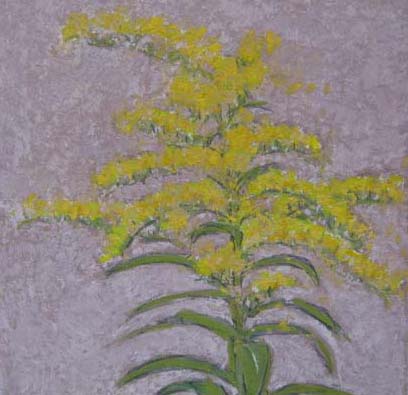
goldenrod

asters

Working on a large painting takes much time.  I'm on my feet six or seven hours of the day when I paint. And often I paint on the same large work until I see it start to move--some days out from the start-- or until the tone up-lifts, or until something else starts stirring.

I simply pause sometimes:  a small color study or two at my drawing table can remind me that there is a middle and end to image-making.  Then I return to the large painting and usually the path ahead in it appears clearer, the time ahead less clumped to the past days.

The two small studies above are pastel and gouache on paper.  Each study is stylized, individuated, stilled.  Actually, asters and goldenrod are group-dwellers:  many, many, blooms are on each clump and many clumps abide in broad patches in the fields.

Sunday, September 19, 2010

color casting

September field

I did this small painting on September 12th.  I've decided to keep it; I've matted it (so, probably I will not work on it more at a later time).  Already the fields have moved on.

Yellows and golds cast widely in the fields now.  In the treelines yellows and ochres are mixing with the greens.  Cool violets show more: golds can affect the greens that way.  Soon the Autumn Fire Colors will blaze forth.  Til then, this golden field furriness nearly makes my arms shiver.  The furriness moves. Can you see/feel this field/this movement too?

Saturday, September 11, 2010

94 on 9.11

This stanza is from 94, a poem by E.E. Cummings.  The poem appears in a book entitled 95 Poems, first published in 1950.  The book is dedicated to marion, his wife.  M found the poem for me:  Sue and Fran gave us a call to let us know that they recited the stanza's words during their marriage vows.  Let us all give the words an airing:

love is the voice under all silences,
the hope which has no opposite in fear;
the strength so strong mere force is feebleness:
the truth more first than sun more last than star

Friday, September 3, 2010

you


rising dove

T and his wife Takako just returned from their home town, where they went to celebrate at their temple the death of T's father.  "My father has been dead for 33 years."  Their priest in Akita, who incidentally is both a Buddhist priest and a medical doctor, talked to T about "you."

In English, in western societies, the word "you" represents you here and now.  In Japanese society "you" represents not only you here and now but also your ancestors.  So, he told T and Takako, you need to appreciate your ancestors.

Today, M's Aunt Betty is passing from the here and now.  Her doctor in Chicago took her off a ventilator and other support this afternoon.  Betty has outlived nearly everyone in her family stories.  Ancestral she will become.  With brothers all around her once again, in the same tense with them again.

Friday, August 20, 2010

away from green

 middle  August  field 

click on sketch to enlarge
Field colors are leaving green. Each day shows more and more spent, drying, browning stalks and flower heads that are going to seed. There are blooms still and even some new blooms. Goldenrod is moving from green to gold.  Joe Pye weed is becoming less carmine, dustier, dustier.  Lemon-yellow blooms of late-year primroses bob, tall in the breezes.  Queen Anne's lace is curling up everywhere, dunn-green, almost brown, almost ashy. But, still in the fields, also, some Queen Anne's lace is startlingly white, lacey, crisp.  Around the blooms the greens are changing, frosting with mildew from humidity of the days and the nights' coolness or simply giving up, no more chlorophyll coming through: too much sun finally and night hours that are advancing.

goldenrod & primrose in the field

In these small paintings, I have the autumn colors underneath and starting to appear above the greens.

Monday, August 9, 2010

curly dock

liatris, goldenrod & curly dock in the field

The curly dock is the dark dry brown "bottlebrush" in the fields in August.  This image is from last year's autumn paintings; this year we are not seeing the goldenrod fully flaming yellow yet.  Maybe we will in another two weeks.

So almost a year later, I am still working in this format:  8x10" or 10x8" views from the fields and treelines.  This image, like the others, is done on a printmaking paper, Stonehenge or Rives BFK.  (For larger pastel painting especially, a favorite paper is 140 lb. Fabriano Artistico, hot-press [smooth, not so much textured] watercolor paper.)  I use several finely sprayed layers of fixative, even on the small works.  I make my own fixative sometimes, and I also like to use Weber Blue Label fixative.  The layering colors are mostly soft pastel, with some charcoal and lead and graphite pencil marks.  The pastels I most often use are the soft, buttery ones from Sennelier and Schminke, and the slightly harder kaolin-based ones from Rembrandt and Winser Newton.  I use other pastels sometimes, but these are my "regulars."

Many years ago I would sometimes use touches of oil pastel, for nubby texture, in combination with the soft pastels, but I have some concern for the non-drying aspect of the mineral oil in oil pastels.  Will there be holes eaten into the paper where the nubby texture marks used to be?  Will the nubby texture marks become darker and darker?  Still, if a painting's surface changes over the years, it is still the same painting, yes?  The same painting with, maybe, more dark curly dock than it had earlier!