Saturday, June 26, 2010

flowers moving on a page


Martin's and Ardean's paintings

Watercolor can be like a splash of color-and-light.  Not often, students can newly try it out with seemingly carefree brushstrokes and arrangement.  Martin and Ardean have done so.  Their colors waft in space, as do flowers in a field, don't they!

A wonderful book, The Wild Braid, has in its last poem, "The Round,"  these final lines:

the still-wet words I scribbled
on the blotted page:
"Light splashed . . ."

I can scarcely wait til tomorrow
when a new life begins for me,
as it does each day;
as it does each day.

(The first line of the poem is  Light splashed this morning  .)

Do find the book, find the poem; these lines are only slight enticement for much, in this poem and in the other poems to enjoy!  The book is a collection of poems and reflections about poetry and gardening by Stanley Kunitz, a small, lovely book made at the end of his very long life.

The students who painted flowers in watercolor class with me are not very old; still, they are living in retirement:  and from the long view they have reached because of age, gosh, they were able to see the splashes and so "scribble" and "blot" toward some small, lovely work.  Ageless sparkles.

Monday, June 14, 2010

away

I've sought out returning geese from my March 10, 2010 entry.  As you can see, away is much the same image as returning geese.  (The haiku by Miura Chora in the same March 10th entry is good for me to read again too.)

away
four leaves of bamboo like a wild goose
for my friend

Away:  a friend has gone.  He will not be returning except when I think of him.  Seeing the four leaves of bamboo as returning or as going away imbues, a bit, this still memorial brushpainting with movement, memory that will move, come and go.

Friday, June 4, 2010

trillium

trillium

Everyone who has come by the studio and seen this small painting on the easel--Eric, Sandi, and Deb come to mind--have immediately recognized and exclaimed "trillium!" as if they are heralding a fond, found friend. The trillium are wonderful in our woods.  In the early spring the woods are dark with leaf mulch and with the dampness of the winter melt, so that when these bright white big blooms on bold green leaves appear, they almost shine.  Welcome indeed, these friends.

While I was sketching up north some weeks ago now, driving around I saw hundreds of trillium covering the woods floor.  I brought sketches back of trillium and of the first northern orchard blooms.  Four small orchard paintings and some small sketches later:  only this week did I get to the trillium.

This trillium painting is gouache and pastel and some charcoal.  I hope it is lively, blooming here on the page/screen.  The three blooms with three broad petals nod slightly, I think, here at us.  And they nod to the time two weeks ago or more, when they were out there among us, out there among the trees.

Saturday, May 29, 2010

becoming summer

Abuzzing

Not as dramatic perhaps as a film (as, for example, the film "Becoming John Malkovich," nor as dramatic as John Malkovich or what we think his life is like; yet, this field is dramatic.  There is much going on.  The greens have become full force, overtaking the lilacs and light blues of the Dames Rockets and the tender yellow-greens of early growth.  Some blue shadows and blue distances have appended to the greens, and my-gosh, bits of autumnal russets have appeared.  Not to mention that there has been much insect activity and alifting of leaves and flowers by the bugs and by breezes and by the wafts of car speed from the nearby highway.

In this small pastel painting I have tried to array the paper with high and abuzzing drama.  Spring is still around:  summer is coming:  summer is already much around us.  There is much strength and activity in our fields these days; yes, in our fields at least there is much vigor.

Thursday, May 27, 2010

tree

M is in San Francisco among like-mindeds.  He found out today that the word "truth" is related, through Indo-European paths, to the word for "tree."

A moveable feast, this word-link, this tracing travel; do you know too about this, these?

Friday, May 21, 2010

bluebird in field

Bluebird in field

One more time I watched a bluebird pause at our park, which of course can look like a field.  Who is to say for the bluebird?  So I made another, fuller image of the bluebird with green "field" all around.  This bluebird is alert, almost quivering.  He did not stay long.  Most years I do not see a bluebird after early spring.

This pastel painting has many layers, so that the printmaking paper will probably bow a bit whenever the humidity becomes high.  If I frame this, I will ask Bud to add a separator between the mat and the paper so that the paper can move more easily with the humidity changes, and so that if any particles of pastel drop, they can drop off between the mat and the paper rather than on the mat.  Bud uses 4-ply matboard strips as a separator.   Some framers use plastic strips that align with the outside edges of the mat and the rabbet of the frame.  Pastel painters use fixative--a kind of sprayed varnish---to fix the pastel particles in place, but some particles inevitably drop over time.  And here in this painting, there are many layers of pastel and a paper that might slightly move:  a call for special care.  This bluebird is still and ready to move:  we'll be prepared as best we can to watch!

Wednesday, May 12, 2010

these lines

These lines by Philip Levine can center me and can carry me, like a mantra.  I keep coming back to these lines, and at one studio I had them up on the wall.

Fact is silence is the perfect water:
unlike rain it falls from no clouds
to wash our minds, to ease our tired eyes,
to give heart to the thin blades of grass
fighting through the concrete for even air
dirtied by our endless stream of words.

Aren't they wonderful!  These lines are from a longer, entirely wonderful poem entitled "He Would Never Use One Word Where None Would Do"  from a book entitled THE MERCY.

I smile widely now when I see his grass blades fighting through the concrete, like Sisyphus, like Detroit (where Philip Levine grew up), like anyone's even small urges to the better, like me amid all the noise I can make and have around me.

Saturday, May 8, 2010

between flitting

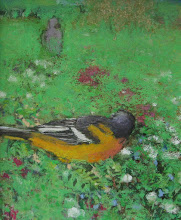
Baltimore Oriole perched, turning

This oriole did not stay around long.  He came into our yard, flitted sideways a few times, sang enormously for awhile, and then was away.  I have not seen him again, three days later now.

Alarming color he flies in with.  Do you have a similarly colored bird in your area?  (Nb. We do not live in Baltimore.)

Bluebird perched for a moment

The park across the street almost looks like a field.  So the bluebird paused there.

This sketch is close to the paper, that is, you can see all the strokes that I used, coming "up" from the first charcoal strokes to the colored watercolor and gouache strokes. (And I left the charcoal here rather than, say, bring in a background color to surround the bird.)   Gouache is basically watercolor with an opaque white, zinc white, added to it.  Often I mix white with my watercolors as I sketch, to give the color some "body" as well as opacity.  European art writers used to use the term "body color" in their descriptions of sketches and I think they were referring to gouache or maybe to lightly-dampened pigment or pastel.  Dry pigment or powdered charcoal and pastel can add wonderful grit and body to brushstrokes of paint.   Paint and pigment and pencil and white and whatever can all mix in in many ways.  Without regard to definition, they flit around, these mixtures!  Still, in the moments that they pause, they can start to form brushstrokes or words, or after awhile, a bird.

Sunday, May 2, 2010

Spring-ing

Spring, Leelanau


Spring racing ^
Spring bursting v
We are
inspiring,
inSpringing,
this Spring:

you too?


Spring, bursting

Saturday, April 24, 2010

pair

dove pair

Being spring, there's been a lot of dancing and pairing among the birds around here.  And nests appear.  Not for long, still, a pair will pause.
This paused pair are mourning doves, charcoal and pastel and a bit of graphite on a tan printmaking paper.  You can probably see the layers of markmaking up from the paper.  These doves are still for a moment, yet the layering gives them some bit of movement on the page, yes?
You can see them also at  Toughdoves.com.

Wednesday, April 14, 2010

Amy, still

April 13, 2010

Almost mid spring, almost mid April:  April 13 we will hereafter especially think of Amy, still, with us.

Wednesday, April 7, 2010

winter to spring

Spring edge of the woods

Colors are coming out of the earth now. Winter—having been mostly about the skies and what was coming through the skies—is now receding as the earth activity presses and opens up. The days—despite still having fits of fierce wind and weather--are mostly about what the earth is up to: what is new, what is coming, colors.

Royal blue scilla and blue-violet glory of the snow and their green leaf clumps are just up. Daffodils are bold and bright. Yellows, lemons, whites, and with dashes of orange, they are high and trumpet-like in their green clumps, above the siennas of the leaf mold and still-damp earth. The bushes show full buds, a few blooms. Some floating yellow forsythia branches are at our woods’ edge. The trees are loaded with catkins, which show as dusty red or dusty gold fuzz around the dark limbs. Full color is rising. Any day now trees and bushes will become color (not lines). And they will buzz. All on earth is starting to teem.

Spring edge of the woods came together quickly, and I used many small marks: of pastel, charcoal, and graphite. I kept it as a sketch rather than develop it further (by defining the daffodils more, for example, or by adding white scilla or violets which were in my pencil thumbnail sketch) because there was a sense of vitality about the sketch.

early spring and rain

Early spring and rain is a small pastel-on-paper painting that I did a day after the sketch above it. On my drive to the studio, I had seen this patch of our neighborhood. Out of rain-soaked air and earth, these trees and lawn came in and out of focus. This “waftiness” of the view, as much as the trees and lawn themselves, is what I was trying to suggest.

Often my style of painting diverges depending on what prompts the work in the first place. I do not mind losing some stylistic cohesion sometimes; still, I do lose some stylistic cohesion sometimes!