Thursday, April 5, 2012

Spring, Easter 2012

crabapple tree at the church yard

I think of Easter, the day when loss becomes new life, as the start of spring.  Here is a poem by E.E. Cummings, spring!may--.  The poem reads a lot like a song, don't you think?

spring!may--
everywhere's here
(with a low high low
and the bird on the bough)
how?why
--we never we know
(so kiss me)shy sweet eagerly my
most dear


(die!live)
the new is the true
and to lose is to have
--we never we know--
brave!brave
(the earth and the sky
are one today)my very so gay
young love


why?how--
we never we know
(with a high low high
in the may in the spring)
live!die
(forever is now)
and dance you suddenly blossoming tree
--i'll sing

Thursday, March 15, 2012

Robins again

Robin

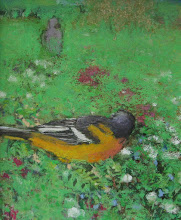
Robins are members of the thrush family.  You can see thrush-like spots on young robins, their shapes are similar to thrush's.  Robins have a way of holding their head high that is distinctive; they may be trying to hear worms this way.  Our robins have been around for at least two weeks, which makes their spring return quite early this year.
This is a small painting, mostly pigment and glue-water, charcoal, and graphite.  Last year's returned robin, quite similar in pose, is posted on the 31st of March, two weeks later!

Wednesday, February 29, 2012

Stillness

Here is a poem by Tomas Transtromer, entitled From March '79.  The translator is John F. Deane.


Tired of all who come with words, words but no language
I went to the snow-covered island.
The wild does not have words.
The unwritten pages spread themselves out in all directions!
I come across the marks of roe-deer's hooves in the snow.
Language but no words.


Today is our leap year day.  Tomorrow is March.  Yesterday was an election day in our state; therefore, we were getting many phone calls and many phone messages with machine voices asking us to vote for Mitt or for Rick.  Phone calls that were not phone calls, words that were not words, machine voices using our first names.  Today the telephone was quiet.  And I came across the poem here, above.
The drawing below is quite large.  This is a detail:  maybe a bit of wildness there.

Thursday, February 16, 2012

bluebirds

Yesterday I told Sally about my day in the studio and she said, "Oh, I love your birds."  So I'll post them here for her and you:  two bluebirds: one is a sketch, and one more detailed and more plumped up from the cold and wind.  It is still winter after all.  Yet we have glimpses of spring, including a few returning bluebirds.
At  Ai-jane.blogspot.com/search/label/bluebird  I have a previous pair of bluebirds: one sketchy and one plumped!


Sunday, February 12, 2012

charcoal in winter

Junco

Snowing by the tracks

sketch for "Snowing"

Charcoal is made from burning wood--charring it--until the wood is velvety soft-hard.  Juncos' heads and napes look charcoal-black.  And the branches they alight upon are charcoal, pre-fired!  So I tried this Junco drawing almost entirely with charcoal.  The winter snow sketch has charcoal under it, almost as a skeleton. (In the sketch you can see the skeletal structure.)  In my studio I have a large can of charcoal powder, but I do not use it much.  The charcoal sticks, though, I love to use.  Strong enough to be crayon-like and to evoke structures (of trees, of railroad yards and such); still, the sticks can stroke paper with that velvety sheen, slight shimmer.

Friday, February 3, 2012

Evening coming


Leonard Cohen just released a new album of songs, Old Ideas.  Joan Didion has a new book, released a few months ago:  Blue Nights.  The album and the book are about mortality, about life aware of death.  Cohen and Didion are, after all, now old.

Their voices are quite different.  Leonard Cohen sounds like gravel.  Almost disintegrating, his very low voice has just enough enunciation to form words and some tune.  Joan Didion's prose is remarkably clear, precise, and detached, like ice when ice is smooth, translucent, and illuminating all contained in it:  but not here.  Her voice has cracked.  Uncomfortable repetitions and occasional confused oldness is in the writing (and still, the book is masterful).

Art with oldness has distinction.  I keep hearing the voices of Leonard Cohen and Joan Didion when they are not in the room.  Here is the refrain of the first song on Old Ideas.  The song is entitled "Going Home."


Going home
Without my sorrow
Going home
Sometime tomorrow
Going home
To where it is better
than before
Going home
Without my burden
Going home
Behind the curtain
Going home
Without the costume
that I wore

Monday, January 2, 2012

fracking protest poem sort of

Here is an a-musing poem from the 16th century in Wales, a time and place where tree religion was losing out and where the English were cutting down the Welsh woods for charcoal-burning.  Robin Clidro is the poet, said to be a native of the Clwyd Valley, who wandered around South Wales until he was killed by a highwayman.

Marchand Wood

Odious and hard is the law
and painful to little squirrels.
They go the whole way to London
with their cry and their matron before them.
This red squirrel was splendid,
soft-bellied and able to read;
she conversed with the Council
and made a great matter of it.
When the Book was put under her hand
in the faith that this would shame her,
she spoke thus to the bailiff,
'Sir Bribem, you're a deep one!'
Then on her oath she said,
'All Rhuthyn's woods are ravaged;
my house and barn were taken
one dark night, and all my nuts.
The squirrels all are calling
for the trees; they fear the dog.
Up there remains of the hill wood
only grey ash of oak trees;
there's not a stump unstolen
nor a crow's nest left in our land.
The owls are always hooting
for trees; they send the children mad.
The poor owl catches cold,
left cold without her hollow trunk.
Woe to the goats, without trees or hazels,
and to the sow-keeper and piglets!
Pity an old red-bellied sow
on Sunday, in her search for an acorn.
The chair of the wild cats,
I know where that was burnt.
Goodbye hedgehog!  No cow-collar
nor pig-trough will come from here any more.
If a plucked goose is to be roasted,
it must be with bracken from Rhodwydd Gap.
No pot will come to bubbling,
no beer will boil without small twigs;
and if peat comes from the mountain
in the rain, it's cold and dear.
Colds will exhaust the housemaid,
with cold feet and a dripping nose.
There's no hollow trunk or branch,
nor a fence for the beating of an old thin snipe.
Yes, Angharad spoke the truth,
if we don't get coal it's goodbye to our land.'

The translation is by Gwyn Williams, and appears in his book WELSH POEMS Sixth Century to 1600.  Nearly every year I look to see and read this poem again, usually around the time of our first snowfalls.  M and I happen to have plenty of squirrels and big old oak trees in our yard; still, the bard's exchange of his voice into the voice of a matron red squirrel impresses me the most!  By the way, Gwyn Williams tells us that according to pre-Christian Greek travellers to Britain, the word bardd, still the Welsh word for a poet, was in use at the beginning of the first century B.C.

Thursday, December 15, 2011

noigandres again

This exchange about a word-mystery, between the American poet Ezra Pound and the language scholar (Doctor) Emil Levy, took place in 1911 in Freiburg:

. . . Doctor, what do they mean by noigrandres?
And he said: "Noigandres! NOIgandres!
You know for seex mon's of my life
Effery night when I go to bett, I say to myself:
Noigandres, eh, noigandres,
Now what the DEFFIL can that mean!"


Emil Levy did solve the word-mystery:  noigandres  means to protect from, to ward off ennui.  And so a lovely line of poetry/song from the Provencal--a language of the medeival troubadours--can now be understood:


E jois lo grans, e l'olors d'enoi gandres
And joy is its seed, and its smell banishes sadness


The provencal poet is conjuring a flower, after he has heard "birdsong that whirls and turns" ("sona e tint e tart").  (All this word-talk can be found in Hugh Kenner's book on Pound in a chapter called The Invention of Language.)


It is a lovely notion, yes, a word appearing again that brings a new way for us to banish sadness.

Thursday, December 8, 2011

Tomas Transtromer's SONG

I told Gretchen I had read a poem at lunchtime that transported me-- with images, movements, a crashing horse on the sea, gulls like ragged sailcloth.  Gosh.  Gretchen said I should put it on the blog:  yes.

Here are the first six stanzas of Tomas Transtromer's Song.  The translation, from the Swedish, is by Robert Hass in his book of poems, Time and Materials.  Vainomoinen is the mythic singer of the songs of the great Finnish epic, The Kalevala.  You can read the entire poem at this link:  SONG  .

SONG


Dressed in the ragged sailcloth of dead ships,
Flecked gray with the smokes of outlawed coasts,
The white flock swelled, the swarms of gulls cried out:


Alarm!  Alarm!  There's something overboard.
They crowded tight to form a signal flag
That, fluttering, reads:  Look sharp!  There's booty here!


So the gulls steered across the water-widths,
Blue pastures striding in the waves' white foam,
A streak of phosphor straightway to the sun.


But Vainomoinen on his ancient journeys
Sparkles on sea swells in the ancient light,
His horse's hooves so swift they're hardly wet.


And back of him the green forest of his songs:
The oak tree poised to leap a thousand years,
A great mill turned by birdsong, and the wind


Imprisons each of the trees in its own roar.
Immense pinecones glimmer in the moonlight
When the sentinel pine ignites and flares.


A great mill turned by birdsong!  Wow.

Friday, November 25, 2011

Tony's Thanks-giving

Tony brought bread, wine, and a book yesterday when he came for our feast of Thanksgiving.  After M opened the champagne, we paused and Tony read:

i thank You God for most this amazing
day:for the leaping greenly spirits of trees
and a blue true dream of sky;and for everything
which is natural which is infinite which is yes


(i who have died am alive again today,
and this is the sun's birthday;this is the birth
day of life and of love and wings:and of the gay
great happening illimitably earth)


how should tasting touching hearing seeing
breathing any--lifted from the no
of all nothing--human merely being
doubt unimaginable You?


(now the ears of my ears awake and
now the eyes of my eyes are opened)


The wonderful poem is by E. E. Cummings.  Yes, wonderful: how indeed doubt-lifting.

 
Deer's there, green, blue
Thanksgivng 2011

Monday, November 21, 2011

Autumn Gold


Here is gold in the early November treeline.
Below is gold in the fields, last year, in late October.  See also ClamorandSense .


And here, below, the Autumn landscape's gold expands, becomes light.

Wednesday, November 9, 2011

gold and silver

late October field

This small painting started with much drawing and detail.  Color grew.
I used several fine sprays of fixative between layers.  The fixative darkens the color just a bit and it allows me to add more pigment, more color.