Thursday, August 11, 2011

poet in view

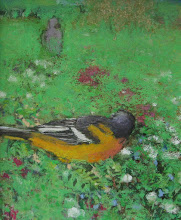
Cardinal in our yard

Philip Levine is the new Poet Laureate of the United States.  Yesterday we got the news, along with snippets of his poetry, his biography, and photos of him.  Fame for him.  Please link here, Philip Levine, to an earlier blog about his wonderful poetry.  Like our cardinals, his poetry flashes brilliance, flitting around in and out of view.

The cardinal is the state bird of many states in the American midwest.  Here I have tried to catch the male's amazing color and some sense of that amazing head, maybe nodding--in gouache, pastel, charcoal and graphite on Stonehenge paper.  Cardinals are clear, loud singers; certainly they add color and song, joy, to our yards.

Tuesday, August 9, 2011

not Plato's cave

dove in mulberry juice and charcoal

My mother will be in a "cave" today, in surgery.
When she comes out, she will see my bird which I send as a message of love.
Truth and metaphor, for Sally.

Tuesday, August 2, 2011

Paris gardens


paintings by Claude Monet


Claude Monet was 82 years old when he agreed to paint 19 panels of paintings that would be arranged in an oval or a circle in museum rooms designed solely for the paintings.  The painting, directly above, consists of four panels.  When I was standing there looking, I was about the size of the brown tree trunk:  large and vast these paintings are!  The imagery is from his gardens at Giverny.  The museum where the paintings were installed is a former greenhouse for orange trees, L'Orangerie, on the other side of a very long garden from The Louvre.

Water gardens and paint become the room; we are a part of a another world.

Monet's health was not great, and his eyesight was bothering him.  Still, he made these amazing paintings.  Mostly, he used brushes that were about an inch wide.  Still, there is amazing variety in the touch and sweep of the brushwork and there is elegance in the economy of the brushwork coming together to form images like water lilies or to animate the passages between the recognizable images.  And the color is gorgeous.  More than anything, Monet knew, loved, and passed on to us a joy of color.

Thursday, July 14, 2011

lake

Lake Michigan
oil/gessoed board


A bit can re-call, can call up the large lake.
I think once again of Yeats's The Lake Isle of Innisfree .

Today in Michigan, Betty Ford is being buried beside her husband, Gerald Ford, who was one of our Presidents.  This bit of news re-calls Betty Ford's large, lovely and brave contribution to our world.

Wednesday, July 13, 2011

daylilies

July daylilies

Floating orange patches all around town now.  Lifting spirits.

Saturday, July 9, 2011

lake views

Lake Michigan near Holland
July 8, c 3:00 pm

The lake looks different from one quarter hour to another and from any slight change of view.  My sister Helen said it looks like the ocean.  


These color sketches I did today and yesterday in the studio, from pencil sketches.  How different these colors are from the colors of the watercolor sketch in the preceding blog entry.

Friday, July 8, 2011

lemon-yellow of primroses

oil sketch on board

You can see the quick layering of this small sketch:  wet and dry strokes of oil paint on a linen-covered cardboard.  Primroses, poppies, and peonies were blooming at the edge of the woods.

Travel and family visits have precluded my regular work weeks, happily.  Still, I can sketch.  Below is a small watercolor sketch of Lake Michigan.

Thursday, June 23, 2011

Saryu's haiku

"willow tree"  calligraphy

Without a brush
The willow paints the wind.

               -Saryu


We brushed this haiku in class Tuesday.  My calligraphy here is somewhat willow-like, breeze-lifted.  While we were in class, outdoors there was great wind.  We were under a tornado warning!

Saryu's surname and his lifespan's dates are not known, evidently (unless you know them).   This haiku is from a book from The Art Institute of Chicago,  Zen Haiku, selections and translations by Jonathan Clements.

Wednesday, June 22, 2011

blue flags

blue flags in the field

Blue flags are a wild iris that grow around here.  They are small and fine, delicate.  Yet, they are tough, they will not give up their patch of  field easily, and they can spread if they have enough water.  The ones I saw were almost hidden, surrounded by field.  Here, the painting has lifted them high in the field, undaunted by the grasses or the woods beyond.

Wednesday, June 15, 2011

woods and flowers

rhododendron and woods

Back and forth between the cultivated and the wild:  most of us like to go there:  you too?

This little painting started as a site sketch at the large garden of a nearby school called Aquinas.  The painting, mostly pastel, also looks emblematic of the site where our friends S and Fr live on Cape Cod.  Their house's yard is surrounded by very large rhododendrons, and the yard verges in the back up to 800-plus acres of protected woods.  We have been much thinking of our friends this month, so this scene, rhododendron and woods, getting through onto my paper as two places, not one, shouldn't surprise me.

Tuesday, June 7, 2011

in the deep heart's core

William Butler Yeats wrote The Lake Isle of Innisfree in 1895.  He was in London, pavements all around, when he heard the sound of water lapping in a fountain and thought of his boyhood/ island/ the sea.  Here is his poem.  Here also is a link to Yeats himself reciting the poem:  http://www.poets.org/viewmedia.php/prmMID/15529  .

I will arise and go now, and go to Innisfree,
  And a small cabin build there, of clay and wattles made;
Nine bean rows will I have there, a hive for the honey bee,
  And live alone in the bee-loud glade.


And I shall have some peace there, for peace comes dropping slow,
  Dropping from the veils of the morning to where the cricket sings;
There midnight's all a glimmer, and noon a purple glow,
  And evening full of the linnet's wings.


I will arise and go now, for always night and day
  I hear lake water lapping with low sounds by the shore;
While I stand on the roadway, or on the pavements gray,
  I hear it in the deep heart's core.


Often I call upon this poem and say some lines and, hearing the words, I am calmed.  This past two weeks I have been in two great cities, Chicago and Boston.  There, amid great strength and beauty; still, Yeats's poem has wafted to me at times, clearly, with music, with magic.

Sunday, June 5, 2011

Gillian's wonderful poem


On the drifting roof
survives a Tsunami dog
hell crossing to sing--


     -Gillian Huang-Tiller
Gillian is brushing up to Issa, which makes her own poem even more layered, wonderful.  Here is Issa (who lived in Japan from 1763 - 1828):


in this world
we walk on the roof of hell
gazing at flowers


     -Issa