Wednesday, May 12, 2010

these lines

These lines by Philip Levine can center me and can carry me, like a mantra.  I keep coming back to these lines, and at one studio I had them up on the wall.

Fact is silence is the perfect water:
unlike rain it falls from no clouds
to wash our minds, to ease our tired eyes,
to give heart to the thin blades of grass
fighting through the concrete for even air
dirtied by our endless stream of words.

Aren't they wonderful!  These lines are from a longer, entirely wonderful poem entitled "He Would Never Use One Word Where None Would Do"  from a book entitled THE MERCY.

I smile widely now when I see his grass blades fighting through the concrete, like Sisyphus, like Detroit (where Philip Levine grew up), like anyone's even small urges to the better, like me amid all the noise I can make and have around me.

Saturday, May 8, 2010

between flitting

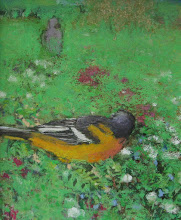
Baltimore Oriole perched, turning

This oriole did not stay around long.  He came into our yard, flitted sideways a few times, sang enormously for awhile, and then was away.  I have not seen him again, three days later now.

Alarming color he flies in with.  Do you have a similarly colored bird in your area?  (Nb. We do not live in Baltimore.)

Bluebird perched for a moment

The park across the street almost looks like a field.  So the bluebird paused there.

This sketch is close to the paper, that is, you can see all the strokes that I used, coming "up" from the first charcoal strokes to the colored watercolor and gouache strokes. (And I left the charcoal here rather than, say, bring in a background color to surround the bird.)   Gouache is basically watercolor with an opaque white, zinc white, added to it.  Often I mix white with my watercolors as I sketch, to give the color some "body" as well as opacity.  European art writers used to use the term "body color" in their descriptions of sketches and I think they were referring to gouache or maybe to lightly-dampened pigment or pastel.  Dry pigment or powdered charcoal and pastel can add wonderful grit and body to brushstrokes of paint.   Paint and pigment and pencil and white and whatever can all mix in in many ways.  Without regard to definition, they flit around, these mixtures!  Still, in the moments that they pause, they can start to form brushstrokes or words, or after awhile, a bird.

Sunday, May 2, 2010

Spring-ing

Spring, Leelanau


Spring racing ^
Spring bursting v
We are
inspiring,
inSpringing,
this Spring:

you too?


Spring, bursting

Saturday, April 24, 2010

pair

dove pair

Being spring, there's been a lot of dancing and pairing among the birds around here.  And nests appear.  Not for long, still, a pair will pause.
This paused pair are mourning doves, charcoal and pastel and a bit of graphite on a tan printmaking paper.  You can probably see the layers of markmaking up from the paper.  These doves are still for a moment, yet the layering gives them some bit of movement on the page, yes?
You can see them also at  Toughdoves.com.

Wednesday, April 14, 2010

Amy, still

April 13, 2010

Almost mid spring, almost mid April:  April 13 we will hereafter especially think of Amy, still, with us.

Wednesday, April 7, 2010

winter to spring

Spring edge of the woods

Colors are coming out of the earth now. Winter—having been mostly about the skies and what was coming through the skies—is now receding as the earth activity presses and opens up. The days—despite still having fits of fierce wind and weather--are mostly about what the earth is up to: what is new, what is coming, colors.

Royal blue scilla and blue-violet glory of the snow and their green leaf clumps are just up. Daffodils are bold and bright. Yellows, lemons, whites, and with dashes of orange, they are high and trumpet-like in their green clumps, above the siennas of the leaf mold and still-damp earth. The bushes show full buds, a few blooms. Some floating yellow forsythia branches are at our woods’ edge. The trees are loaded with catkins, which show as dusty red or dusty gold fuzz around the dark limbs. Full color is rising. Any day now trees and bushes will become color (not lines). And they will buzz. All on earth is starting to teem.

Spring edge of the woods came together quickly, and I used many small marks: of pastel, charcoal, and graphite. I kept it as a sketch rather than develop it further (by defining the daffodils more, for example, or by adding white scilla or violets which were in my pencil thumbnail sketch) because there was a sense of vitality about the sketch.

early spring and rain

Early spring and rain is a small pastel-on-paper painting that I did a day after the sketch above it. On my drive to the studio, I had seen this patch of our neighborhood. Out of rain-soaked air and earth, these trees and lawn came in and out of focus. This “waftiness” of the view, as much as the trees and lawn themselves, is what I was trying to suggest.

Often my style of painting diverges depending on what prompts the work in the first place. I do not mind losing some stylistic cohesion sometimes; still, I do lose some stylistic cohesion sometimes!

Saturday, April 3, 2010

scroll, practice

qing                             yong

The scroll on the right shows the Chinese character yong, which means "forever," "eternity."  The Japanese use the same character, though they pronounce it eiYong (ei) contains the pictogram of water; maybe you can see the brushstrokes here as rivulets, as flow. The character is made of hand-ground ink on paper, mounted on the scroll, and I have added my vermilion red seal.

The five characters on the left, qing, are ink on practice paper.  The paper is thin, tough, and highly absorbent, carefully torn from a roll.  Here you can see that the brushstrokes vary according to relative wetness and pressure of the brush (in the first (top-right) character, qing, and the fourth character, kuai, you can see grey ink).  If you "scroll" down to my next blog entry, qing is explained a little more.

Calligraphy I practice almost every week alongside some students.  We become still--centered--and moving with the brush when we practice, and sometimes the calligraphy is good.

Thursday, April 1, 2010

plum

qing

This is a calligraphy practice from Tuesday night's class. Reading top to bottom, right to left:
qing     lao     i  kuai  r 
green   old      together    =    Young and Old Together

Sandi and I also practiced some plum blossom painting.  The plum is a symbol of hope and endurance, blooming as it does so early--even in the snow--and blooming often on branches that are very old.

Sandi's granddaughter Alexis practiced with us.  Such a young, talented calligrapher in our midst.

plum practice


Saturday, March 27, 2010

Norman, M, and E.E.


Norman Friedman started Spring.  M now is the editor of Spring.  E.E. Cummings wrote this ever-lifting poem about Spring:

in Just-
spring      when the world is mud-
luscious the little
lame balloonman

whistles      far      and wee

and eddieandbill come
running from marbles and
piracies and it's
spring

when the world is puddle-wonderful

the queer
old balloonman whistles
far        and        wee
and bettyandisbel come dancing

from hop-scotch and jump-rope and
it's
spring
and
     the

         goat-footed

balloonMan    whistles
far
and
wee
 

(Complete Poems 27)                  

We still have, in our neighborhood, an ice cream truck that comes around.  The ice cream man who dishes out our ice cream cones is almost always happy-looking and humming to the tune from his little truck.  Or else we are so glad to see him again after the long winter, we see him happy and humming.  E.E. must have had a balloon vendor come around each spring to his boyhood neighborhood of Cambridge Massachusetts.

Norman Friedman has given friends and friends of poetry exceedingly many treats:  thankstohim.

Sunday, March 21, 2010

thankyou Dylan Thomas

Is there any line in English poetry that better heralds spring than this line from Dylan Thomas:
The force that through the green fuse drives the flower
Drives my green age;
Every spring, again this spring, this line comes to me.  Thankyou Dylan Thomas.  Here is the entire poem, whose title is the same as the line above.

The force that through the green fuse drives the flower
Drives my green age; that blasts the roots of trees
Is my destroyer.
And I am dumb to tell the crooked rose
My youth is bent by the same wintry fever.

The force that drives the water through the rocks
Drives my red blood; that dries the mouthing streams
Turns mine to wax.
And I am dumb to mouth unto my veins
How at the mountain spring the same mouth sucks.

The hand that whirls the water in the pool
Stirs the quicksand; that ropes the blowing wind
Hauls my shroud sail.
And I am dumb to tell the hanging man
How of my clay is made the hangman's lime.

The lips of time leech to the fountain head;
Love drips and gathers, but the fallen blood
Shall calm her sores.
And I am dumb to tell a weather's wind
How time has ticked a heaven round the stars.

And I am dumb to tell the lover's tomb
How at my sheet goes the same crooked worm.


crocuses, spring


Monday, March 15, 2010

daffodils

daffodils in field

These daffodils are up before the daffodils outside are.  That is because I hung this painting Saturday at an exhibition space.  The painting is up; the daffodils are showing!  Outdoors the daffodils are only stubby shoots.  Each day now, more show themselves coming through.  Funny looking (and what a funny painting they'd make):  still, these stubs are mood-brightening!

The painting here is oil on canvas, quite large for me: 30 x 40 inches.

Wednesday, March 10, 2010

returning geese

si bi luo yan

Four leaves of bamboo painted in such a way that they are said to be luo  yan, "like a wild goose alighting."  This is an instruction to painting students, on a page in The Mustard Seed Manual of Painting, in the chapter on Bamboo.  Each time I practice this arrangement, the wild goose/bamboo leaves look different:  sometimes pensive, sometimes free, sometimes a bit gangly!  We have returning geese in our skies every day now, and we can hear their honking above us often before we even see them.  Oh wonderful reunions.

Emerging from
the regions of the moon--
the first wild geese

(Hatsukari ya
tsuki no soba yori
arawaruru)

I came across this haiku, by Miura Chora (1729 - 1780), in a 1995 exhibition book entitled HAIGA by Stephen Addiss.  A haiga, a haiku-painting, by Chora was on the same page with the haiku.  It is lovely, three black geese.  I hope that you and I see this haiga (again) and more of Chora's work someday.